- Articulation
- Refers to how speech sounds are made. Speech-language pathologists (SLPs) may work on specific sounds or patterns of sounds. For example: An SLP may help a child correct his prevocalic /r/ sound, so instead of wabbit, he can say rabbit.
- Voice
- Refers to using the vocal cords and breath to produce sounds. SLPs may work on decreasing vocal abuse which can lead to hoarseness, vocal fold nodules, etc. Hypernasality (too much air through the nose) and hyponasality (not enough air through the nose on nasal sounds) may also fall under this heading.
- Fluency
- Refers to the rhythm and smoothness of speech. If fluency is disrupted, a person may stutter or hesitate when communicating.

Showing posts with label Child Development. Show all posts
Showing posts with label Child Development. Show all posts
Wednesday, May 16, 2012
So, what is the difference between language and speech? Part 2: Speech
Speech relates meaning with sounds; it is the verbal means of communicating. Speech includes 3 areas:
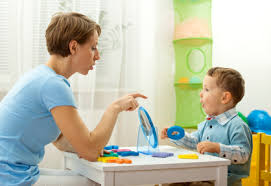 Speech disorders and language disorders can present together or independently of one another and severity can range from a mild issue to a severe one. If you have any concerns or questions regarding your child's speech and/or language development, please do not hesitate to contact us at 615-898-7461 or info@brightbeginningsptc.com.

Tuesday, May 15, 2012
So, what is the difference between language and speech? Part 1: Language
In our experience, many parents, healthcare professionals, and daycare workers do not know that there is a difference between language skills and speech skills or what that difference looks like.
Language is made up of socially shared rules which communicate a message. Language involves:
From Children's Hospital of Pittsburgh http://www.chp.edu/CHP/P02170
Language is made up of socially shared rules which communicate a message. Language involves:
- Knowing the meaning of words
- Example: Someone asks a child, "Where do you go to school?" and the child begins naming students in her class. The child knows that they are supposed to respond, but they answer the question incorrectly.
- Using/combining words to communicate a message effectively and clearly
- Example: A toddler points to an out of reach item and requests "want," but the parent is unsure of what the toddler is requesting exactly because the child does not have the vocabulary to label the object.
- Example: Labeling all four-legged animals with a tail a "dog."
- Understanding the social rules (i.e., pragmatics) of language.
- Example: A child is talking to another classmate about his favorite subject, dinosaurs. The classmate is not interested in talking about dinosaurs, but the child does not pick up on social cues (i.e., classmate glances around the room, attempts to engage the child in another topic are unsuccessful, sighs, rolls his eyes).
The examples listed above are just a small pieces of language. Language can be broken down into many areas including semantics (meaning/vocabulary), syntax (sentence structure), morphology (word structure/ word endings), phonology (the sounds within a language), and pragmatics (social rules of language). A child may have a deficit in one language area or deficits across several areas.
Language can be both verbal and nonverbal. For example: a child can request a cookie by pointing and saying the label "cookie." The child's pointing is nonverbal communication and the child's word is verbal communication. If you remove either part of the communication, you would most likely still understand the child's request.
Below is a chart from the Children's Hospital of Pittsburgh. It contains both speech and language milestones. If you have any questions about your child's speech or language, do not hesitate to contact Bright Beginnings at 615-898-7461 or info@brightbeginningsptc.com.
Age-Appropriate Speech and Language Milestones
Age-Appropriate Speech and Language Milestones
The ability to hear is essential for proper speech and language development. Hearing problems may be suspected in children who are not responding to sounds or who are not developing their language skills appropriately. The following are some age-related guidelines that may help to decide if your child is experiencing hearing problems.
It is important to remember that not every child is the same, and children reach milestones at different ages. Consult your child's physician if you are suspicious that your child is not developing speech and language skills correctly. The National Institute on Deafness and Other Communication Disorders (NIDCD) and other experts list the following age-appropriate speech and language milestones for babies and young children.
Milestones related to speech and language:
| Birth to 5 months |
|
|---|---|
| 6 to 11 months |
|
| 12 to 17 months |
|
| 18 to 23 months |
|
| 2 to 3 years |
|
| 3 to 4 years |
|
| 4 to 5 years |
|
| 5 years |
|
From Children's Hospital of Pittsburgh http://www.chp.edu/CHP/P02170
Monday, May 7, 2012
Mother Knows Best
Often times parents come with us with the gut feeling that something is not quite right about their child's development. Too often, these parents say that they have discussed their concerns with others and are told things like:
- "Oh, all boys are like that. He will catch up."
- "She will eat when she gets hungry enough."
- "Send him to our house and we will take care of it."
- "Give it more time. My son was a late talker and he is doing fine."
Parents are the experts on their children and should always trust their instincts. When you have specific developmental concerns, you should discuss them with your child's pediatrician or a specialist in that developmental area.
Subscribe to:
Posts (Atom)